How to check a concrete quote in Dubbo
To check a concrete quote in Dubbo, ask for the concreter's licence details and check them, make sure the quote lists what is included, and ask how the concreter handles hot weather, the footpath crossing and dust. Seven checks follow. They are questions, not rules: none of them tells you what your job needs, and the concreter decides how the work is done.
Your enquiry is passed to a local concreter, and this site does not quote. What moves a quote up or down is in the cost factors guide. This page is about reading the quote that arrives.
The seven checks, in order
- Licence details. The NSW Government page on general concreting work says a licence or certificate is needed for general concreting work valued at more than $5,000 in labour and materials, including GST. For anything else, such as smaller jobs or commercial or industrial slabs, ask NSW Fair Trading. Ask the concreter for their licence details and check them on the NSW Government licence check, which shows the holder's name, licence number, expiry date and status.
- What the agreement says. The NSW Government page on questions to ask before hiring suggests asking for the licence number and for references or reviews, and getting the agreement to state the total, the start and completion dates and what counts as complete. The licence guide covers the paperwork NSW expects for bigger jobs.
- What is included. Ask for removal of old concrete, base preparation, reinforcement, joints, falls and drainage connection, curing and clean-up to be named line by line. This is our own checklist, not a regulator's list.
- Hot weather and curing. Ask how the concreter plans for hot, windy days and how the slab is cured. The cracking and curing guide has the Dubbo climate figures. We do not advise a pour time, and neither do the sources we read.
- The footpath crossing. If the driveway crosses the footpath, ask whether the concreter is accredited with Dubbo Regional Council and who lodges the application. Council asks for permission first and for the application at least two weeks before the planned start. See the crossover guide.
- Dust control. SafeWork NSW says concrete can contain silica dust. Ask how dust is controlled when old concrete is cut or broken out. The removal guide covers the controls it names.
- Scope questions from an interstate list. A Queensland regulator's list of common driveway and path defects gives useful prompts about falls, joints and foundations. They are below.
What a vague quote can hide
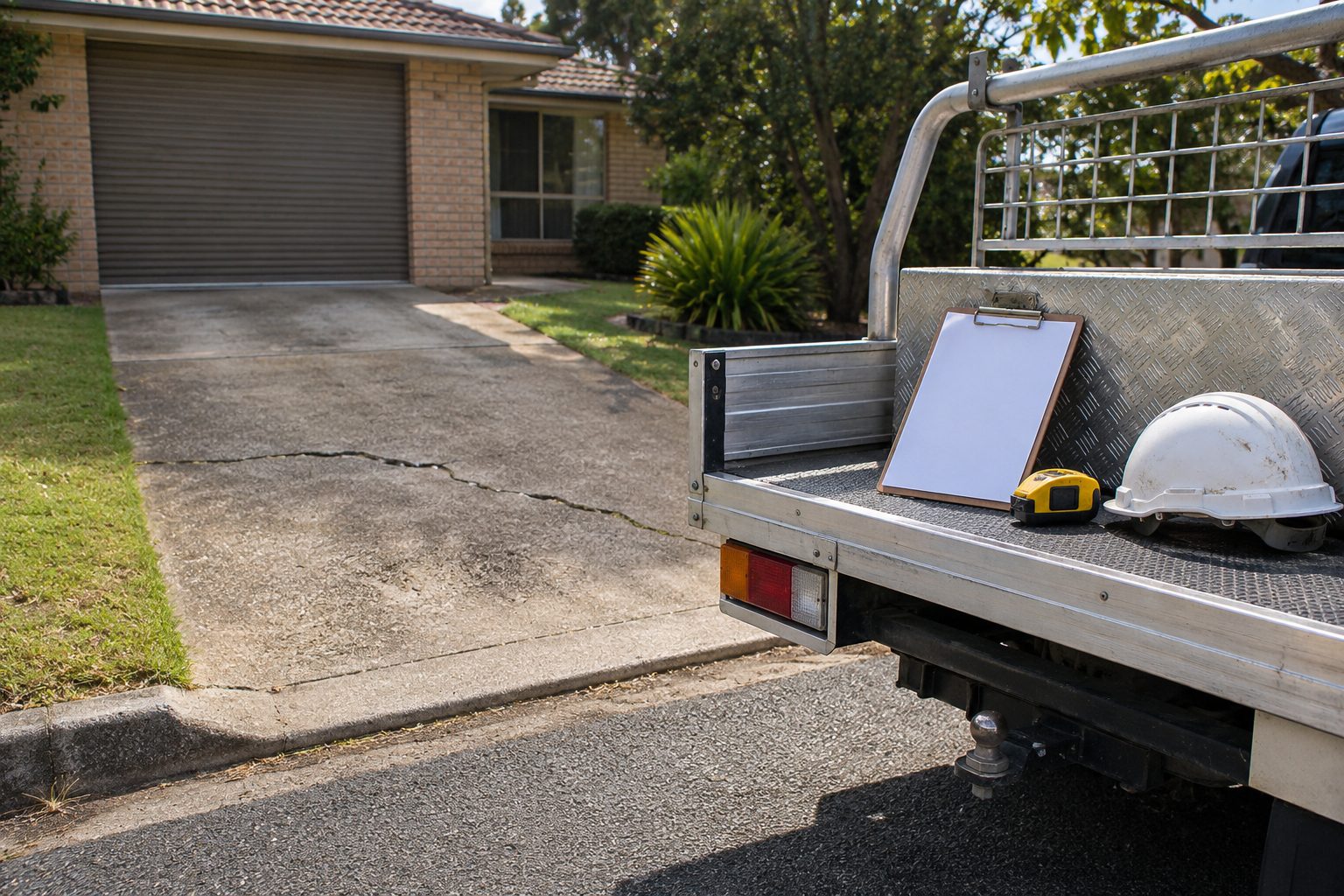
A quote with one total and a line such as "supply and lay concrete" tells you little. It may or may not include the base, the reinforcement, the joints, the falls, the curing, the removal of old concrete, the footpath crossing or the clean-up. Each of those is either in the price or it is not, and a silent line is a question, not an answer.
Ask the concreter to say, for each item, whether it is included, and to put the answer in writing. If something is left out on purpose, such as an old driveway you will remove yourself, the quote should say so.
Scope questions from a Queensland list
The Queensland Building and Construction Commission, a Queensland regulator, publishes a list of common driveway and path defects (the Queensland regulator's list). It is an interstate source and not NSW guidance, so we use it only as a set of prompts for scope questions.
- Falls and ponding. The list names water pooling at slab edges from incorrect falls. Ask how falls are set and where water runs, including whether it runs toward the house or a neighbour.
- Joints at walls. It names missing isolation joints where a slab meets a wall or a rigid structure. Ask where joints will go.
- Reinforcement position. It says reinforcement often fails when mesh drops to the bottom of the slab. Ask how reinforcement is held in place.
- Foundations. It names soft or uneven foundations. Ask how the base is prepared and checked.
- Hot, windy days. It links fast drying in hot, windy weather to early surface cracks. Ask how the concreter slows that down.
Comparing two or three quotes line by line
Put the quotes side by side and fill in one row per item. If a cell is blank on a quote, ask the concreter about it before you decide.
| Quote line | What to look for in each quote |
|---|---|
| Area | How it was measured, and whether edges and widening are inside it |
| Base and levels | What preparation is described and who checks the levels |
| Reinforcement | Whether it is named and how it is supported |
| Joints | Where they go and how they are formed |
| Falls and drainage | Which way water runs and where it ends up |
| Finish | The finish named, and a sample or photo if it is decorative |
| Curing | What the concreter does after the surface is finished, including on hot days |
| Old concrete | Whether removal is included, and how dust is controlled |
| Footpath crossing | Whether it is in or out, and who deals with council |
| Clean-up | What is left on site when the concreter finishes |
| Licence details | Supplied, and checked on the NSW Government licence check |
When the quote and the job do not match
If the finished work differs from the quote, raise it with the concreter first, in writing, and keep photos and the quote. This is where an itemised quote earns its place, because you can point to the line. NSW Fair Trading can explain the next steps. The licence guide covers the paperwork NSW expects for bigger jobs, and the enquiry form is the place to start if you want your details passed to a local concreter.
What this guide cannot do
This guide cannot tell you whether a quote is fair, whether a concreter holds the licence or certificate that applies, or whether a particular result is a problem. It offers questions only. The Queensland list is an interstate source, and the climate and council points come from the pages named in the box below. We are a referral service: your enquiry goes to a local concreter, who is responsible for holding any licence or certificate that applies. Check the details yourself before you say yes.
Check the current rules before you rely on this
This page describes questions to ask when checking a concreting quote in Dubbo, drawing on NSW Government, Dubbo Regional Council, SafeWork NSW and Queensland regulator pages. It describes the rules in general terms as they stood in November 2026. Standards, forms, thresholds and fines change.
The authoritative sources are NSW Government, checking your contractor or tradesperson is qualified, NSW Government, questions to ask before hiring a tradesperson or builder, NSW Government, general concreting work (licence or certificate), Dubbo Regional Council, driveways, footpaths and landscaping (road reserve works), Queensland Building and Construction Commission, driveways and paths: a walk-through of common defects (Queensland, interstate) and SafeWork NSW, work safely with crystalline silica and engineered stone. Where anything here differs from those sources, they are right and we are not.
We are not concreters, builders, certifiers, regulators or lawyers. For what applies to your job, ask the concreter for their licence details and check them on the NSW Government licence check, ask NSW Fair Trading if you are unsure, and ask the council that covers the land about approvals.
Accurate at the time of writing, November 2026. Always check the source before relying on it.