Concrete driveway cost in Dubbo: why this page has no prices
Concrete driveway cost in Dubbo depends on the site, so this page lists what moves a quote and publishes no figures. A single price or range would be wrong for most driveways, and it would not come from a concreter who has seen your block. The factors below tell you what to describe when you ask, and what to look for when two quotes arrive with different totals.
Your enquiry is passed to a local concreter, who decides what to quote and is responsible for holding any licence or certificate that applies. This guide covers the drivers only. The quote check guide holds the questions to ask and the list of what a written quote should show.
The factors that move a driveway quote
Each factor in the table is something a concreter usually has to allow for. The list is our own editorial checklist, not a set of figures from any publisher, and the concreter decides how each factor is handled on your job.
| Factor | How it moves a quote | What to tell the concreter |
|---|---|---|
| Size and shape | More area and more edges mean more concrete, more forming and more finishing. Curves and angles add work compared with a straight run. | Rough length and width, and any bend or widening for parking |
| Finish | Plain, coloured, exposed aggregate, stencilled and stamped finishes are different jobs, so a quote usually changes with the choice. The finishes guide describes each in a line. | The finish you have in mind, or a photo of one you like |
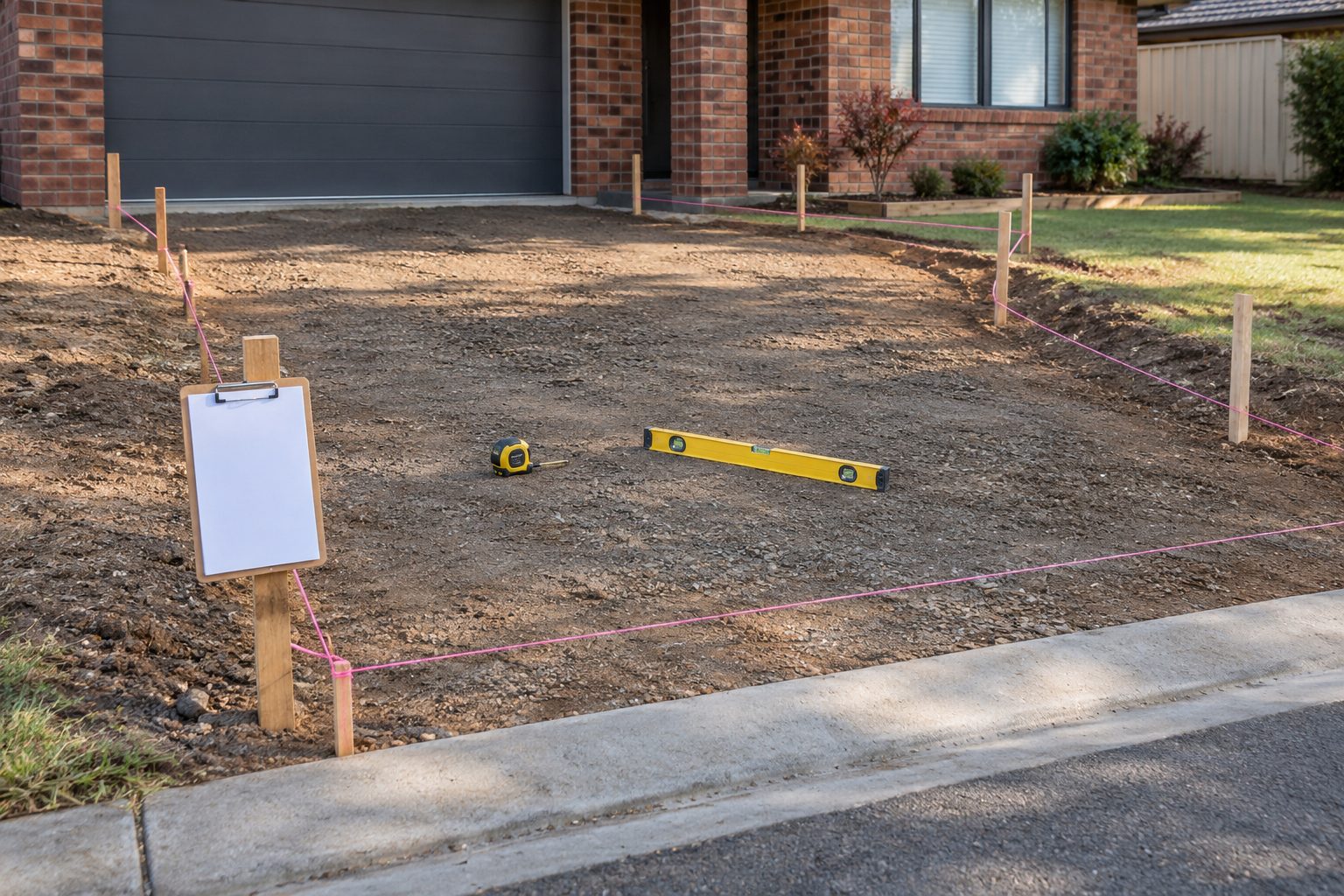
| Base and levels | The ground under the slab has to be prepared and brought to levels before concrete goes in. Soft or uneven ground can mean more work. | What is there now: grass, gravel, old concrete or fill |
| Slope or regrading | A steep block, or a driveway that needs regrading, is more work than a flat one, and falls and drainage have to be planned either way. | Which way the ground falls and where water goes now |
| Access | Whether a concrete truck, and a pump if one is needed, can reach the site changes how the concrete is placed. | Gate or driveway width, overhead wires, trees, a narrow street |
| Old driveway | Breaking out existing concrete adds a task, and cutting it makes dust that has to be controlled. See the removal guide. | Whether old concrete must come out and roughly how much |
| Footpath crossing | The section across the footpath and kerb is built in the road reserve and has its own steps. See below. | Whether the driveway crosses the footpath or kerb |
| Joints, falls and drainage | Where joints are cut, how the surface falls and where water leaves the slab are part of the work and belong on the quote. | Where water flows from the house and the street today |
| Curing in hot weather | Dubbo has many days at or above 35 degrees C, so a concreter may plan extra steps to protect the surface. See below. | Your preferred timing |
| Timing | Waiting for suitable weather, or for other trades to finish, can change when a concreter is able to start. | Any deadline, such as a move-in date |
The factors are not equal. On a flat, open block with a plain finish, size may matter most. On a sloping block with an old driveway to remove, the removal and the base work may matter more. When two quotes are far apart, compare them factor by factor before you compare the totals.
Size, finish and base work
Size is the easiest factor to see and the easiest to misjudge. Ask how the area was measured, and whether the edges, any widening at the kerb and the path to the door sit inside the figure. A bigger driveway usually means more concrete, but it is one factor among several. A small driveway on a hard slope with old concrete to remove can need more work than a larger flat one.
Finish changes the job as well as the look. The sources we read give no price or performance comparison between finishes, so ask the concreter what the finish involves and what the quote lists for it.
Base preparation is the part you cannot see once the concrete is in. A quote that names base preparation and levels, and says what is allowed for, is easier to compare than one that does not mention them.
The footpath crossing in Dubbo
If the driveway crosses the footpath or kerb, that section is built in the road reserve. Dubbo Regional Council's page on driveways, footpaths and landscaping says council permission is needed first and that only accredited contractors may build footpath driveways and crossover slabs. Applications are made through council's online portal and go in at least two weeks before the planned start. Ask the concreter whether they are accredited with Dubbo Regional Council and who lodges the application. The crossover guide sets the steps out in order.
Hot weather and the Dubbo summer
Bureau of Meteorology figures for Dubbo Airport show how hot the summers are. Records from 1993 give a mean maximum of 33.7 degrees C in January, and the station averages 32.2 days a year at or above 35 degrees C, 12.0 of them in January (Dubbo Airport climate statistics). That is a reason to ask how the concreter plans to place and cure the slab on hot, dry and windy days. The sources we read set no pour times and no temperature limits, so we give none. The cracking and curing guide goes through what they do say.
Getting quotes you can compare
A quote that lists items separately is easier to compare than a single total. Describe the same job to each concreter: the same area, the same finish, whether old concrete comes out and whether the driveway crosses the footpath. Then read the lines side by side. Where one quote is silent on an item, ask rather than assume it is included.
A short, clear enquiry helps. Send the suburb or town, a photo of the site, the rough size, the finish you have in mind, how a truck would reach it and any date that matters. The enquiry form asks for exactly these. Ask the concreter for their licence details and check them on the NSW Government licence check, and see whether the driveway page or the approvals guide raises anything about your lot that you should tell them.
What this guide cannot do
This guide cannot tell you what your driveway will cost, and it does not say which factor will matter most on your block. It publishes no prices because one figure would mislead most readers. The factor list is an editorial checklist, not a regulator's list. We are a referral service: your enquiry goes to a local concreter, who inspects the site, decides what to quote and is responsible for holding any licence or certificate that applies.
Check the current rules before you rely on this
This page describes the factors that change a concrete driveway quote in Dubbo, using Dubbo Regional Council and Bureau of Meteorology information. It describes the rules in general terms as they stood in November 2026. Standards, forms, thresholds and fines change.
The authoritative sources are Dubbo Regional Council, driveways, footpaths and landscaping (road reserve works), Bureau of Meteorology, climate statistics for Dubbo Airport AWS (station 065070), NSW Planning, driveways, pathways and paving (development types) and NSW Government, general concreting work (licence or certificate). Where anything here differs from those sources, they are right and we are not.
We are not concreters, builders, certifiers, regulators or lawyers. For what applies to your job, ask the concreter for their licence details and check them on the NSW Government licence check, ask NSW Fair Trading if you are unsure, and ask the council that covers the land about approvals.
Accurate at the time of writing, November 2026. Always check the source before relying on it.