Commercial concreting in Dubbo: what a hardstand is
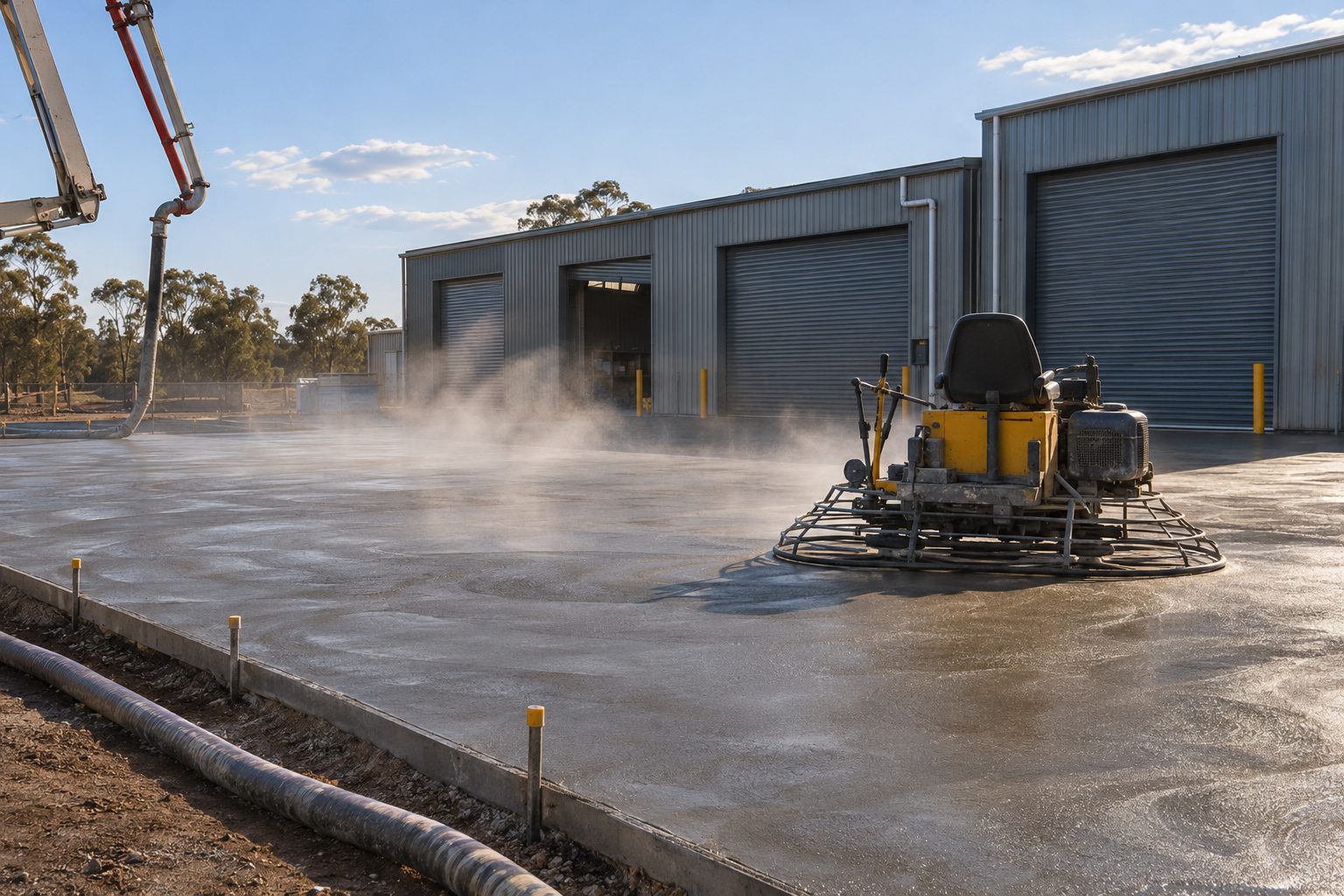
A hardstand is a flat concrete area built to carry vehicles, machinery or stored goods, such as a yard, a loading apron or the floor of a shed or workshop. Commercial concreting in Dubbo covers hardstands, industrial floors and slabs for small businesses and farms with light commercial use. This site is a referral service: your enquiry is passed to a local concreter, who does the work and is responsible for holding any licence or certificate that applies.
The decisions that matter come before the pour. What will stand or drive on the slab, how water leaves it and how a concrete truck and pump reach it are the main ones. They change what a concreter has to design and what a quote has to list.
What to define before you ask for a quote
| Define | Detail to give the concreter |
|---|---|
| Use | Cars, utes, trucks, forklifts, machinery or stored goods, and how often. |
| Loads | The heaviest vehicle or item, and whether loads are concentrated on small wheels or legs. |
| Area and shape | Overall size, edges, and any existing slab to join or cut. |
| Falls and drainage | Which way water should run, and where it connects. |
| Joints and edges | Where joints suit the layout, and how edges meet buildings and gates. |
| Access | Gate width, overhead lines, soft ground, and room for a truck and a pump. |
| Hours and downtime | When the site can be shut, and how long it can stay out of use. |
| Existing concrete | What is to be cut or broken out, and when. |
Nothing here sets a thickness, strength or joint spacing. The sources we read give none that is safe to repeat, so the concreter has to say what they are using and why.
Loads and standards, without the numbers
The NSW planning pages on driveways and hardstands name the Australian Standards for off-street car parking and commercial vehicle facilities (NSW Planning page on driveways and hardstands). We have not read those standards, so this page says nothing about what is in them. HIA's guidance on residential pavements says industry guidance sets different minimum strength and thickness for foot traffic, cars and heavier vehicles (HIA article on pavements and cracking). HIA also says the residential pavement standard is for guidance only and not referenced in the National Construction Code.
The practical question is: ask your concreter what they are using for your loads, and why. Ask them to put it in the quote. A hardstand for a delivery truck and a floor for a workshop are different jobs, even if they look alike on a plan.
Licence and approval for commercial slabs
The NSW Government page on general concreting work says a licence or certificate is needed for general concreting work valued at more than $5,000 in labour and materials, including GST. The pages we read cover work over that amount only. For commercial or industrial slabs, the pages we read do not say, so ask NSW Fair Trading. Ask the concreter for their licence details and check them on the NSW Government licence check. The licence guide covers the paperwork NSW expects for bigger jobs.
The pages we read also do not state an approval pathway for a commercial slab. Approval depends on the project; ask council or a certifier. If the work is near a house or part of a larger build, the house slabs page covers the residential side.
Dust when cutting or breaking out old concrete
SafeWork NSW says concrete can contain silica dust, and that using water to control dust while cutting concrete is an effective control, along with on-tool dust extraction (SafeWork NSW guidance on working safely with silica). Cutting a slab for a joint, a drain or a new edge makes dust. Ask the concreter how dust is controlled on your site. The removal guide goes through the questions. This site does not say that any concreter complies.
Local context for commercial work
At the 2021 Census, the largest employing industries in the Dubbo urban centre were hospitals (5.9 per cent of employment), other social assistance services (4.4), aged care residential services (3.1), primary education (2.8) and state government administration (2.5) (ABS QuickStats, Dubbo urban centre). Meat processing was among the top industries in the Dubbo East area at 2.5 per cent (ABS QuickStats, Dubbo East). Census data says nothing about concreting, so these are background only.
Road freight transport is a top-five industry in Narromine (ABS QuickStats, Narromine suburb) and in Trangie (ABS QuickStats, Trangie urban centre). Dubbo Regional Council's 2024/25 annual report counts 525 development applications determined, including 418 dwellings (council annual report extract). The Narromine and Trangie page has the local facts there. To compare written quotes, use the quote check, then send your details through the enquiry form.
What this page cannot do
It cannot design a hardstand or floor, set a thickness, strength or joint layout, or say what loads a slab can take. It cannot say whether a commercial or industrial slab needs a licence or certificate, because the pages we read do not say, or what approval the project needs. It cannot give a price. Ask the concreter what they are designing to and why, ask NSW Fair Trading about licensing, and ask Dubbo Regional Council or a certifier about approval. An engineer should be asked about heavy or unusual loads.
Check the current rules before you rely on this
This page describes what to define before asking for a commercial slab or hardstand, and what the public pages say and do not say about licensing. It describes the rules in general terms as they stood in November 2026. Standards, forms, thresholds and fines change.
The authoritative sources are NSW Government, general concreting work (licence or certificate), Housing Industry Association, designing pavements to avoid cracking (24 May 2022), SafeWork NSW, work safely with crystalline silica and engineered stone, ABS 2021 Census QuickStats, Dubbo (urban centre and locality) and Dubbo Regional Council, 2024/25 Annual Report (first part only). Where anything here differs from those sources, they are right and we are not.
We are not concreters, builders, certifiers, regulators or lawyers. For what applies to your job, ask the concreter for their licence details and check them on the NSW Government licence check, ask NSW Fair Trading if you are unsure, and ask the council that covers the land about approvals.
Accurate at the time of writing, November 2026. Always check the source before relying on it.