Why does concrete crack?
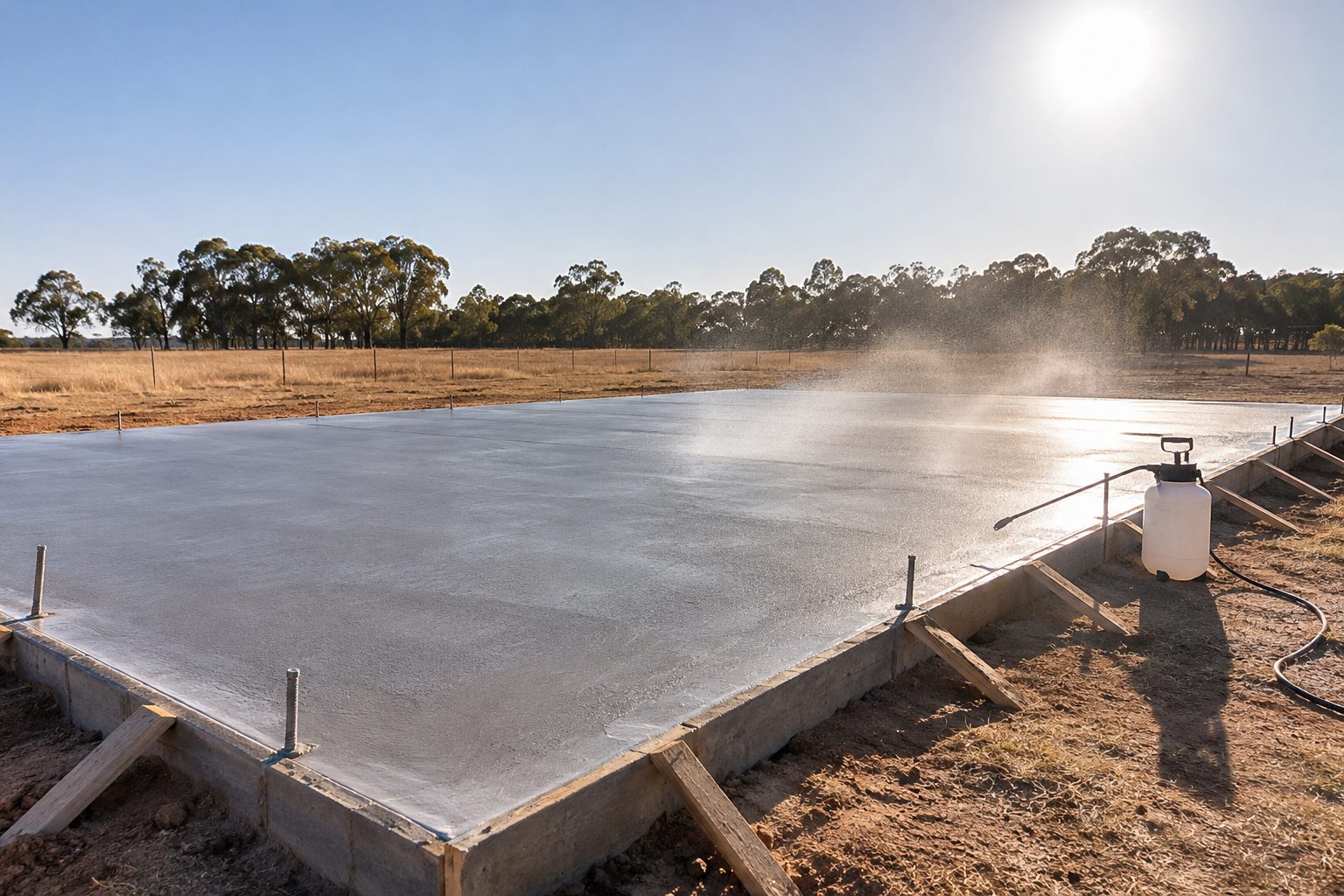
Why does concrete crack? The sources we read point to movement, drying and environmental conditions. A concrete supplier's technical page says hot days, wind and low humidity, together or separately, can cause cracks and reduce the time the concrete can be worked. In Dubbo that is worth knowing, because the Bureau of Meteorology's Dubbo Airport station averages 32.2 days a year at or above 35 degrees C. This guide sets out what the sources say about cracking, joints and curing, and where they stop.
It is general information. It cannot say why a particular slab cracked or whether a crack matters, and we do not classify cracks. For that, ask the concreter, and ask NSW Fair Trading if you are unsure what to do next.
What the Dubbo Airport climate figures show
The Bureau of Meteorology publishes climate statistics for its Dubbo Airport station, which has been open since 1946 and sits 284 m above sea level. The temperature statistics start in 1993 and the rainfall means in 1994. The table gives the monthly means for the two figures that matter most to a pour.
| Month | Mean maximum (degrees C) | Mean rainfall (mm) |
|---|---|---|
| January | 33.7 | 58.4 |
| February | 32.2 | 47.2 |
| March | 29.3 | 66.7 |
| April | 24.9 | 38.5 |
| May | 20.1 | 42.1 |
| June | 16.4 | 48.4 |
| July | 15.7 | 43.1 |
| August | 17.7 | 38.0 |
| September | 21.6 | 40.7 |
| October | 25.3 | 48.0 |
| November | 28.8 | 61.0 |
| December | 31.6 | 58.9 |
| Whole year | 24.8 | 587.5 |
Hot days are counted separately. The station records mean days a year with a maximum at or above a set temperature:
- At or above 35 degrees C: January 12.0, February 7.0, March 2.2, November 3.3 and December 7.3, with 32.2 across a whole year.
- At or above 40 degrees C: January 2.4, February 1.0, November 0.4 and December 0.8, with 4.7 across a whole year.
- Highest on record at the station: 46.1 degrees C.
Humidity and wind come from observations for 1993 to 2010. Mean relative humidity at 9 am is 67 per cent over the year and at 3 pm it is 41 per cent. Summer 3 pm figures are lower, at 30 per cent in December, 32 in January and 36 in February. Mean 3 pm wind is about 18 to 20 km/h in spring and summer over the same period.
Mean rainfall is 587.5 mm a year across 58.4 rain days of 1 mm or more. The monthly means are spread across the year, with no marked dry season. The sources we read do not say what rain does to a pour, so ask the concreter how they handle a forecast of rain.
What a concrete supplier's technical page says
The supplier page makes a short list of points we can pass on. It is a technical page from a concrete supplier, so treat it as industry information and not as a regulator's rule.
- Hot days, wind and low humidity, together or separately, can cause cracks and reduce working time.
- Prompt application of curing compound is very important.
- Frequent applications of an evaporation retarder can help stop water evaporating from the surface.
- Plan adequate joints and cut them as soon as possible.
- The concrete drying out can cause unsightly cracking.
In plain terms, the supplier page ties cracking to the surface drying out too fast, and its remedies are curing compound, an evaporation retarder and joints that are planned and cut early. The page gives no spacing for joints, no number of days for curing and no rule for rain, so we give none. Ask the concreter what they use, when they apply it and where the joints go.
What the Queensland list says about slab problems
The Queensland Building and Construction Commission, a Queensland regulator, publishes a walk-through of common driveway and path defects. It is an interstate source and not NSW guidance. The points that bear on cracking are:
- Cracking is linked to movement, drying and environmental conditions.
- Reinforcement often fails when mesh drops to the bottom of the slab.
- Fast drying in hot, windy weather can cause early surface cracks.
- Soft or uneven foundations are named as a cause of problems.
- Isolation joints are missing where a slab meets a wall or other rigid structure.
We use the list as a set of questions for the concreter, not as a standard for a Dubbo job. It does not tell us whether a given crack matters, and we do not either.
What industry guidance says about curing
The Housing Industry Association published an article on designing pavements to avoid cracking on 24 May 2022. It says the Australian Standard for residential pavements, which HIA describes as guidance only and not referenced in the National Construction Code, covers curing, and its figures differ by the kind of traffic the pavement carries. Industry guidance sets different minimum strength and thickness for foot traffic, cars and heavier vehicles. We do not repeat any figures, because we have not read the standard. Ask your concreter what they are using and why.
What the sources do not say, and what to ask
The sources we read give no preferred months for pouring in Dubbo, no temperature limits for a pour, no time before a slab can take traffic, no sealing interval, no number of days for curing and no joint spacing. They do not advise a time of day for a pour. For all of these, the answer should come from the concreter who has seen your site.
- How will you plan for hot, windy days? Ask what changes on a day like that.
- How will the slab be cured? Ask what is used, when it goes on and how long the surface is protected.
- Where will the joints go? Ask also when they are cut.
- When can the slab take traffic? Ask for the answer for your site and the loads involved.
- What happens if rain is forecast? Ask about the start date and the surface.
The same questions suit a driveway, a shed or garage slab or a path or patio. The quote check guide shows where to look for the answers on a written quote, and you can send an enquiry with a photo of the site.
What this guide cannot do
This guide cannot say why a particular slab cracked, whether a crack matters or when a slab can take weight. The sources are a supplier's technical page, an interstate regulator's list and an industry article, and none of them sets out rules for Dubbo. The climate figures come from one Bureau of Meteorology station and are averages, not forecasts. We are a referral service: your enquiry goes to a local concreter, who decides how to place and cure the slab and is responsible for holding any licence or certificate that applies.
Check the current rules before you rely on this
This page describes why concrete cracks and how curing and hot weather matter in Dubbo, using Bureau of Meteorology figures and industry and interstate regulator pages. It describes the rules in general terms as they stood in November 2026. Standards, forms, thresholds and fines change.
The authoritative sources are Bureau of Meteorology, climate statistics for Dubbo Airport AWS (station 065070), Bureau of Meteorology, Dubbo Airport AWS, all climate statistics (station 065070), A concrete supplier's technical page: how to minimise concrete cracking, Queensland Building and Construction Commission, driveways and paths: a walk-through of common defects (Queensland, interstate) and Housing Industry Association, designing pavements to avoid cracking (24 May 2022). Where anything here differs from those sources, they are right and we are not.
We are not concreters, builders, certifiers, regulators or lawyers. For what applies to your job, ask the concreter for their licence details and check them on the NSW Government licence check, ask NSW Fair Trading if you are unsure, and ask the council that covers the land about approvals.
Accurate at the time of writing, November 2026. Always check the source before relying on it.