Do you need council approval for a concrete slab in Dubbo?
Do you need council approval for a concrete slab, path or driveway? It depends on the project and the lot, and the pages we read do not settle it for every case. NSW state rules list limits for driveways, hard stand spaces, paths and paving, and say that work which cannot meet all of them can only go ahead after the council approves a development application. Whether a job meets them is for Dubbo Regional Council to say, and it offers a free Duty Planner appointment on (02) 6801 4000, which is council's own number.
This page prints the state limits as we read them in November 2026, so you can see what to ask about. It does not say whether your job qualifies, because only council or a certifier can say that for your lot. Check the current version of every rule before you rely on it. Planning approval, the footpath crossing and licensing are three separate things: the crossing is on the crossover guide, and licence details are on the licence guide.
What exempt development means
In the version we found, the state planning policy uses the term exempt development for work that can go ahead without a development application if it meets every listed criterion. The rules sit in the State Environmental Planning Policy (Exempt and Complying Development Codes) 2008. NSW Planning explains the driveway, path and paving rules on its page on driveways, pathways and paving and in a rules sheet for exempt development, and the NSW Planning Portal carries a version too. We read the versions returned as in force when we looked, and the pages did not show their dates, so check the current version.
The rules sheet says that if you cannot meet all of the criteria, driveways, hardstands, pathways and paving can only be installed after the council approves a development application.
Driveways and hard stand spaces: the state limits
These are the headline limits for a driveway or hard stand space, as we read them. "Ancillary to a dwelling" means serving a house.
| Item | Limit in the version we found |
|---|---|
| Cut or fill | Not more than 600 mm above or below existing ground level if ancillary to a dwelling, and not more than 1 m otherwise. |
| Hard stand size | At least 2.6 m wide by 5.4 m long, with an area of not more than 20 square metres. |
| Position | If ancillary to a dwelling, at least 1 m behind the building line of any road frontage and at least 900 mm from each side or rear boundary. |
| Total hard surfaces | Driveways, hard stand spaces, pathways and paved areas on a residential or rural lot together not more than 15 per cent of the lot area or 150 square metres, whichever is less. |
| Landscaped area | In residential zones, forward of the building line, at least 25 per cent where the lot width is 18 m or less and at least 50 per cent where it is wider. |
| Drainage | Surface water or runoff must go to a drainage system connected to the existing stormwater drainage system. |
| Width | The driveway must not be wider than the associated open hardstand space, carport or garage. |
| Crossings | The driveway must follow the relevant road authority's policies for vehicle crossings. See the crossover guide. |
| Excluded land | Not exempt on land in foreshore areas, environmentally sensitive areas or heritage conservation areas, or on or within a heritage item. |
| Trees | If a tree needs removing or pruning, contact the council first. |
The planning pages name the Australian Standards for off-street car parking and commercial vehicle facilities as design standards for driveways and hardstands. We do not quote them. Council also says that driveway runoff flows to the stormwater system and that only clean rain water should enter it (Dubbo Regional Council, stormwater).
Paths and paving
Pathways and paving have their own limits in the same policy. In a residential zone or RU5, cut or fill must be not more than 600 mm, and in other zones not more than 1 m. The same total hard surface limit and the same landscaped area rules apply as for driveways, and the work must not reduce the landscaped area required along a boundary with a road or with an adjoining lot where a dwelling is located.
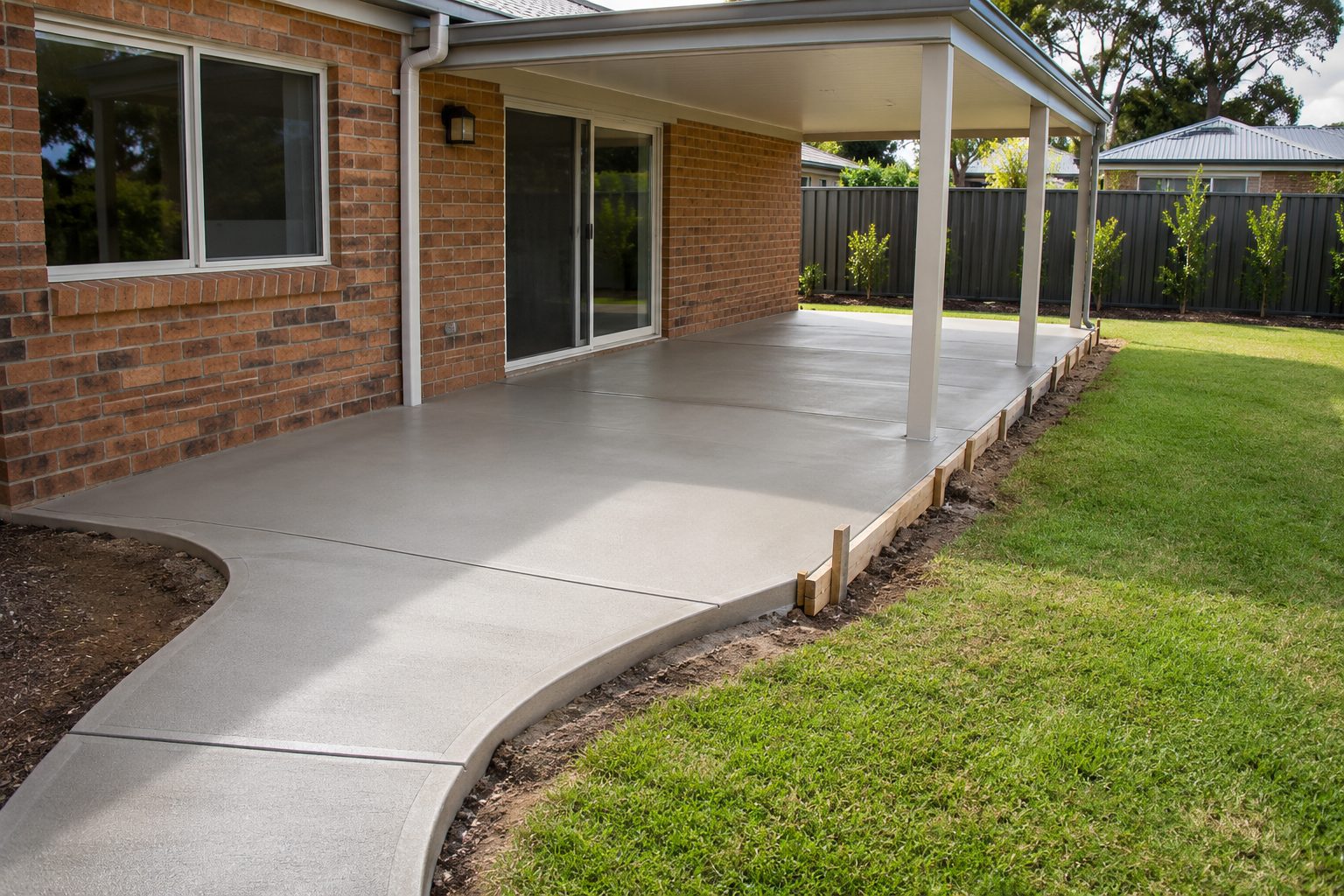
The pages we read do not say whether a patio slab is covered by the approval for the structure above it, so ask council or a certifier. The paths, patios and alfresco page covers falls, joints and drainage.
Sheds and garden sheds
The same policy has criteria for garden sheds, as returned when we looked. In zones RU1, RU2, RU3, RU4, RU6 or R5, a garden shed must have a floor area of not more than 50 square metres, a height of not more than 3 m above existing ground and a distance of 5 m from boundaries. In other zones the figures given were 20 square metres and 900 mm. A shed must be a Class 10 building and not habitable, with not more than two on a lot, and the criteria exclude sites with heritage items, foreshore land or environmentally sensitive areas.
NSW Planning's page on outbuildings in rural areas says proposed changes to shed and farm building size requirements were on exhibition and are still being considered, so check the current limits. The pages we read do not say whether the floor slab of a shed is covered by the shed exemption, and we do not know which of the shed zones Dubbo land falls into. Ask council or a certifier before the slab is poured. The shed and garage slabs page names the issue and what to tell a concreter.
When a development application is needed
Dubbo Regional Council's page on types of development applications says a development application is needed if a project cannot be exempt or complying development. It tells readers to use the Dubbo Regional Local Environmental Plan 2022 and the NSW ePlanning Spatial Viewer to find their zone, and offers the free Duty Planner appointment on (02) 6801 4000. We do not say which zone any Dubbo street or suburb is in.
For garage slabs, house slabs and commercial slabs, approval depends on the project, so ask council or a certifier. The Dubbo Development Control Plan 2013 has an element on detached development, outbuildings, sheds and garages, but we read only the first part of the document, so we cannot say what it requires (Dubbo DCP 2013).
What this page does not settle
- Whether your lot, zone or overlay matches the state criteria.
- Whether a shed's floor slab is covered by the shed exemption.
- The approval pathway for garage, house and commercial slabs.
- Any council planning requirement beyond what is named on this page.
- The footpath crossing, which has its own steps on the crossover guide.
The driveways page covers buying questions and finishes. When you are ready, send an enquiry with your suburb, council area and a photo of the site.
What this guide cannot do
This guide cannot tell you whether work on your lot counts as exempt development, whether you need a development application or what council will decide. The limits are copied from state planning pages as returned in November 2026, the pages did not show their dates, and the rules change. The limits are not specifications for your job. We are a referral service: your enquiry goes to a local concreter, who is responsible for holding any licence or certificate that applies. Ask Dubbo Regional Council, or a certifier, about your lot before any work starts.
Check the current rules before you rely on this
This page describes the NSW exempt development limits for driveways, paths, paving and garden sheds, and what Dubbo Regional Council says about development applications, in the versions we found. It describes the rules in general terms as they stood in November 2026. Standards, forms, thresholds and fines change.
The authoritative sources are NSW legislation, State Environmental Planning Policy (Exempt and Complying Development Codes) 2008, in force version as returned, NSW Planning, driveways, pathways and paving (development types), NSW Planning, driveways, hardstands, pathways and paving: rules for exempt development (February 2023), NSW Planning Portal, exempt development: driveways, pathways and paving and Dubbo Regional Council, types of development applications. Where anything here differs from those sources, they are right and we are not.
We are not concreters, builders, certifiers, regulators or lawyers. For what applies to your job, ask the concreter for their licence details and check them on the NSW Government licence check, ask NSW Fair Trading if you are unsure, and ask the council that covers the land about approvals.
Accurate at the time of writing, November 2026. Always check the source before relying on it.