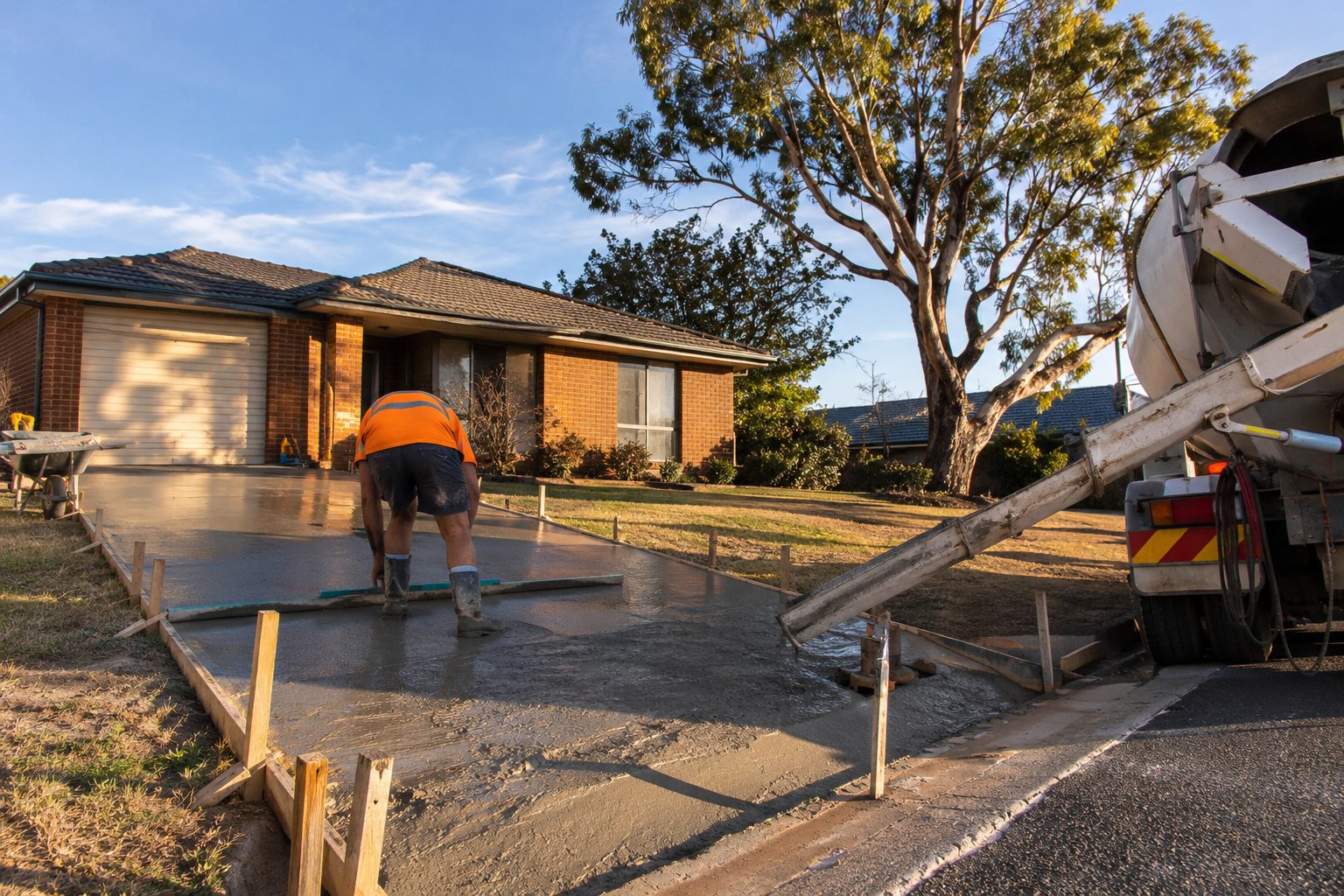
Concreters in Dubbo for Driveways & Slabs
Cracked driveway, or a slab to pour? Your enquiry is passed to a local Dubbo concreter.
Tell us what the concrete is for and where
The suburb or town, what you want poured or replaced, and a rough size are enough to begin. A photo of the site helps. Your enquiry is passed to a local concreter in Dubbo or nearby, who comes back to you. This site does not pour concrete or quote work.
Request a quote
Concreters in Dubbo: a regional city of separate houses
Concreting for a house in Dubbo usually means a driveway, a path, a patio, a garage or shed slab, or a slab for a new house. At the 2021 Census the Dubbo urban centre had about 38,783 people, and 81.7 per cent of its occupied dwellings were separate houses (ABS QuickStats, Dubbo urban centre). In the Dubbo Regional local government area, with about 54,922 people, 85.3 per cent of occupied dwellings were separate houses (ABS QuickStats, Dubbo Regional).
Dubbo Regional Council's 2024/25 annual report, as far as we could read it, lists 436 residential dwellings approved and 968 new residential blocks (council annual report extract). Those counts use different methods, so they are not added together here.
What to settle before you book a concreter
- What the concrete is for, and how bigA driveway, a shed floor, a house slab and a hardstand all ask different things of the concrete. Say the use and a rough size.
- The suburb or town, and which councilDubbo Regional Council covers Dubbo and Wellington. Narromine Shire Council is a separate council. See the Narromine page.
- Whether the driveway crosses the footpathIn Dubbo that part has its own steps. See the crossover guide.
- Old concrete to removeCutting and breaking out make dust. See the removal guide.
- The finish you have in mindPlain, coloured, exposed aggregate or stencilled. See the finishes guide.
- Access for a concrete truckTell the concreter about gates, slope, overhead lines and where a truck can stand.
- A quote in writingItemised, so two quotes can be compared. See how to check a quote.
- The licence details to checkAsk for them and check them. The licence guide covers the paperwork NSW expects for bigger jobs.
Concrete driveways, slabs, paths and hardstands in Dubbo
Concrete driveways
Plain, coloured, exposed aggregate and stencilled driveways, the state limits, estate plans and the footpath crossing.
Read more →Shed & garage slabs
The approval question first, who to ask at council and what to tell the concreter about the building.
Read more →House slabs & footings
What council planning text says about the ground, what a geotechnical report is for and what to ask about design.
Read more →Paths, patios & alfresco areas
Falls, joints at walls and drainage, using an interstate defect list as a set of questions.
Read more →Commercial slabs & hardstands
What to define before you ask for a hardstand or industrial floor, and the dust questions for cutting and breaking out.
Read more →Before you hire a concreter in Dubbo
Read what the NSW Government says about licensing before you agree to a job. In the version we found, its page on general concreting work describes a licence or certificate for jobs above a set value. That page is the authority, so read it rather than rely on this summary. For smaller jobs or anything it does not cover, ask NSW Fair Trading. Ask the concreter for their licence details and check them on the NSW Government licence check.
Planning approval, permission for a footpath crossing and licensing are three separate things. See the licence guide, the approvals guide and the crossover guide. The cost guide lists what changes a driveway quote, and the cracking and curing guide deals with hot Dubbo summers.
Local facts about concreting in Dubbo
ABS figures are from the 2021 Census and are background only. They say nothing about concreting.
| Fact | Figure | Source |
|---|---|---|
| People, Dubbo urban centre | About 38,783 | ABS QuickStats |
| Rented dwellings, Dubbo urban centre | 36.6 per cent of occupied dwellings | ABS QuickStats |
| People, Dubbo Regional local government area | About 54,922 | ABS QuickStats |
| Development applications determined, 2024/25 | 525, including 418 dwellings | Council annual report extract |
| Population estimate, Dubbo region | 57,639 residents (a REMPLAN forecast), 1.25 per cent annual growth, 66,332 projected by 2041 | Council annual report extract |
Dubbo's climate in a few numbers
Bureau of Meteorology records for Dubbo Airport (temperature records from 1993) put the annual mean maximum at 24.8 degrees C and the January mean maximum at 33.7 degrees C (Bureau of Meteorology, Dubbo Airport). The station averages 32.2 days a year at or above 35 degrees C, and 4.7 at or above 40 degrees C. Mean annual rainfall is 587.5 mm, with monthly means spread across the year. Summer 3 pm humidity in the 1993 to 2010 observations was about 30 to 36 per cent.
The sources we read give no pour-month advice and no drive-on time, so this site gives none. Ask the concreter how they plan for hot, windy days and how they cure. The cracking, curing and hot weather guide sets out what the sources do and do not say.
Dubbo, Wellington, Narromine and the Orana
- Keswick and SouthlakesThe south-east growth area.
- West Dubbo and DelroyHousing facts and the western growth areas.
- South DubboEstablished housing and replacing old concrete.
- WellingtonThe same council area as Dubbo, with Geurie nearby.
- Narromine and TrangieFarm and shed slabs, and local facts for both towns.
What a concreting quote should itemise
This site publishes no prices. Ask each concreter to spell out the same items in writing, so the quotes can be compared line by line.
| Line | What to ask |
|---|---|
| Area and how it was measured | The size in the quote, and whether it was measured on site. |
| Base and reinforcement | What is done to the ground, and what steel is used and where. |
| Joints | Where they go and how they are cut. |
| Falls and drainage | Which way water runs and where it ends up. |
| Finish | Plain, coloured, exposed aggregate or stencilled, and a sample. |
| Curing | How the slab is protected while it sets, including on hot days. |
| Old concrete | Whether it is removed, and how dust is controlled. |
| Council steps and clean-up | Who handles any council steps, and what is left on site. |
| Licence details | The details the concreter gives, so you can check them. |
The quote check guide goes through each line, and the contact page lists what to send with an enquiry.
What this site does and does not do
What this site cannot do
This site cannot pour, quote, inspect or certify concrete. It cannot say whether your job needs a licence or certificate beyond what the NSW Government page says, whether it needs council approval, or what slab your ground and building need. It cannot confirm that any concreter holds a licence. Those questions belong to the concreter, the regulator, council, a certifier and an engineer where one is involved. Ask each of them, and check the sources linked on the page.
Check the current rules before you rely on this
This page describes how to ask a concreter in Dubbo for work, the NSW licence statement, the footpath crossing steps in Dubbo and local climate and census facts. It describes the rules in general terms as they stood in November 2026. Standards, forms, thresholds and fines change.
The authoritative sources are NSW Government, general concreting work (licence or certificate), Dubbo Regional Council, driveways, footpaths and landscaping (road reserve works), ABS 2021 Census QuickStats, Dubbo (urban centre and locality), Bureau of Meteorology, climate statistics for Dubbo Airport AWS (station 065070) and NSW Planning, driveways, pathways and paving (development types). Where anything here differs from those sources, they are right and we are not.
We are not concreters, builders, certifiers, regulators or lawyers. For what applies to your job, ask the concreter for their licence details and check them on the NSW Government licence check, ask NSW Fair Trading if you are unsure, and ask the council that covers the land about approvals.
Accurate at the time of writing, November 2026. Always check the source before relying on it.
Towns and districts covered:
Questions people ask before booking a concreter
Do concreters in NSW need a licence, and what does the NSW Government say?
In the version we found, the NSW Government page on general concreting work describes a licence or certificate for general concreting work above a set value, quoted there as $5,000 in labour and materials including GST. The pages we read cover work over that amount only, so for anything else ask NSW Fair Trading. Ask the concreter for their licence details and check them on the NSW Government licence check. The concreter is responsible for holding any licence or certificate that applies.
Do I need council approval for a concrete driveway or slab?
It depends on the project and the lot. The NSW planning pages say the state rules set limits on area, ground level changes, setbacks and drainage for driveways, paths and paving, and a job that cannot meet them needs a development application. For house, garage and commercial slabs, approval depends on the project, so ask council or a certifier. Dubbo Regional Council offers a free Duty Planner appointment.
Who approves a driveway crossing in Dubbo?
Dubbo Regional Council's page on driveways, footpaths and landscaping says council permission is needed first and applications are made through its online portal. It says only accredited contractors may build footpath driveways and crossover slabs in the road reserve, and the application goes in at least two weeks before the planned start of work. Ask the concreter whether they are accredited with Dubbo Regional Council and who lodges the application.
Why does concrete crack, and does Dubbo's summer matter?
Cracks have several causes. A concrete supplier's technical page says hot days, wind and low humidity, together or separately, can cause cracks and shorten working time, and that joints should be planned and cut early. Bureau of Meteorology records show Dubbo Airport averages 32.2 days a year at or above 35 degrees C. Ask the concreter how they plan for hot, windy days and how they protect the slab while it sets.
How long before I can drive on a new driveway?
The sources we read give no drive-on time, so this site gives none. It depends on the mix, the weather and how the slab is protected while it sets, and the concreter decides. Ask your concreter when the slab can take foot traffic and when it can take a car, and ask why. Get the answer before the pour, and keep vehicles off until they say so.
How much does a concrete driveway cost in Dubbo?
This site publishes no prices, because one figure would be wrong for most sites. What moves a quote includes the size and shape, the finish, base preparation and levels, slope, truck access, removal of old concrete and any footpath crossing. Ask for itemised written quotes and compare them line by line. The cost guide on this site goes through each factor.
What should a concreting quote include?
Ask for the area and how it was measured, base preparation, reinforcement, joints and where they go, falls and the drainage connection, the finish, curing, removal of old concrete, who handles any council steps, clean-up and the licence details the concreter gives. The quote check guide explains each line and what a vague quote can hide.
Does this site do the concreting?
No. This is a referral service. Your enquiry is passed to a local concreter, who does the work and is responsible for holding any licence or certificate that applies. The site does not pour concrete, quote work or sign agreements, and it publishes no price list. Photographs on the site are illustrative only and do not show specific jobs.
Send a suburb, a size and a photo
The suburb or town, what the concrete is for, roughly how big it is and how a truck can reach it.